

Learning, Brought to Life
Great learning starts with more than content. It starts with understanding the people, the problem, and the experience that will make the learning stick.
The case study below highlights a project delivered by HumanKind Learning team members in previous roles. Client and program identifiers have been removed, but the challenges, creative approaches, delivery methods, and results are real.
What experience will help this learner understand, remember, and act?
Case Study 3 : Recognizing Human Trafficking
Multimedia development for a national anti-trafficking training program
Capabilities demonstrated
Multimedia development · 2D animation and motion graphics · Professional narration · On-screen text and visual learning elements · Storyboard development · Character and visual-style development · Client branding and visual-standard alignment · Integration of client-provided source content and graphical assets · Stakeholder review and revision cycles · Draft-to-final multimedia production · Accessible media with closed captions · Section 508 / WCAG 2.1 AA–aligned production
Project Snapshot
Goal: Help frontline professionals recognize when something isn’t right, and know what to do next.
Development: Six months
Course Length: 25 minutes seat time
Team: Multidisciplinary instructional, creative, live-action, animation, and development team
Audience: Frontline aviation professionals
Delivery: 2D animation, motion graphics, professional narration, and on-screen text, integrated with scenario-based instructional design and live-action scenario segments
Accessibility: Accessible by design. Section 508 / WCAG 2.1 AA–aligned, with closed captions and an accessible screen-description transcript
Impact: Developed in support of a nationally recognized anti-trafficking initiative
Experience That Built HumanKind
This project was completed by HumanKind Learning team members in prior professional roles, before HumanKind Learning was formed. It’s presented here to show the experience, responsibilities, and capabilities those team members now bring to HumanKind Learning.
The Challenge
Human trafficking rarely presents itself as an obvious moment.
For frontline aviation professionals, the challenge is often recognizing patterns: behaviors, interactions, inconsistencies, or circumstances that may seem ordinary on their own but become meaningful when considered together.
The training needed to help learners identify those indicators while avoiding another danger: oversimplifying an extraordinarily complex human issue.
This could not be a course built around stereotypes, sensational imagery, or a checklist that implied there was one obvious picture of what trafficking looks like.
Learners needed to understand what they might realistically encounter, how to recognize when something warranted attention, and how to respond through the appropriate reporting channels without placing themselves or a potential victim at greater risk.
The learning had to be memorable.
But more importantly, it had to be responsible.


The HumanKind Approach
To connect on a human level, the experience was built around realistic human situations. Learners observed behavior, relationships, body language, and communication patterns as they unfolded, rather than reading a list of warning signs.
Professional narration, on-screen text, 2D animation, and motion graphics carried the instruction, while live-action scenario segments carried the humanity of the people involved.
The goal was never to turn learners into investigators. It was to help them notice when something might be wrong, and know what to do next.
“Human trafficking awareness is not about teaching people to identify a particular type of person. It is about helping them recognize when a situation deserves a closer look.”
Getting the Story Right
The subject matter demanded an unusually thoughtful scripting and review process.
The instructional and scriptwriting team developed the material from approved client source content and worked closely with client representatives responsible for ensuring the scenarios reflected the experiences of trafficking victims and survivors.
The work moved through repeated stakeholder review and revision cycles. Scenes were reviewed for instructional accuracy, language, behavior, tone, and victim representation. Client feedback sometimes meant significant rewriting, and the team treated that as an essential part of the design process rather than a delay.
When learning represents people who have experienced exploitation, creative ownership matters less than getting the story right. It was a principle that shaped the entire project.
The scenarios needed enough emotional reality to help learners understand what they were seeing without turning trafficking into spectacle. Characters needed to feel like people rather than instructional devices. And moments designed to attract learner attention could never come at the expense of dignity.

Building the Experience
This was multimedia development in the fullest sense. Professional narration, timed on-screen text, 2D animation, and motion graphics were built as an integrated whole, with live-action scenario segments woven in. The team integrated the client’s established branding and previously developed graphical assets, maintaining visual consistency with existing client materials throughout.
Motion design was used selectively to clarify rather than dramatize. That restraint became part of the creative direction.
The team combined:
- Professional narration synced to timed on-screen text
- 2D animation and motion graphics
- Storyboard development and survivor-informed script review
- Scenario-based instructional design
- Character and visual-style development within established client brand standards
- Integration of client-provided source content and graphical assets
- Realistic live-action scenario segments
- Visual reinforcement of trafficking indicators and reporting concepts
- Accessible media with closed captions and a screen-description transcript
- Standards-based delivery for the client’s learning environment
The different media worked together toward one goal: helping learners recognize subtle information without reducing a complicated human experience to a list of warning signs.
What We Built
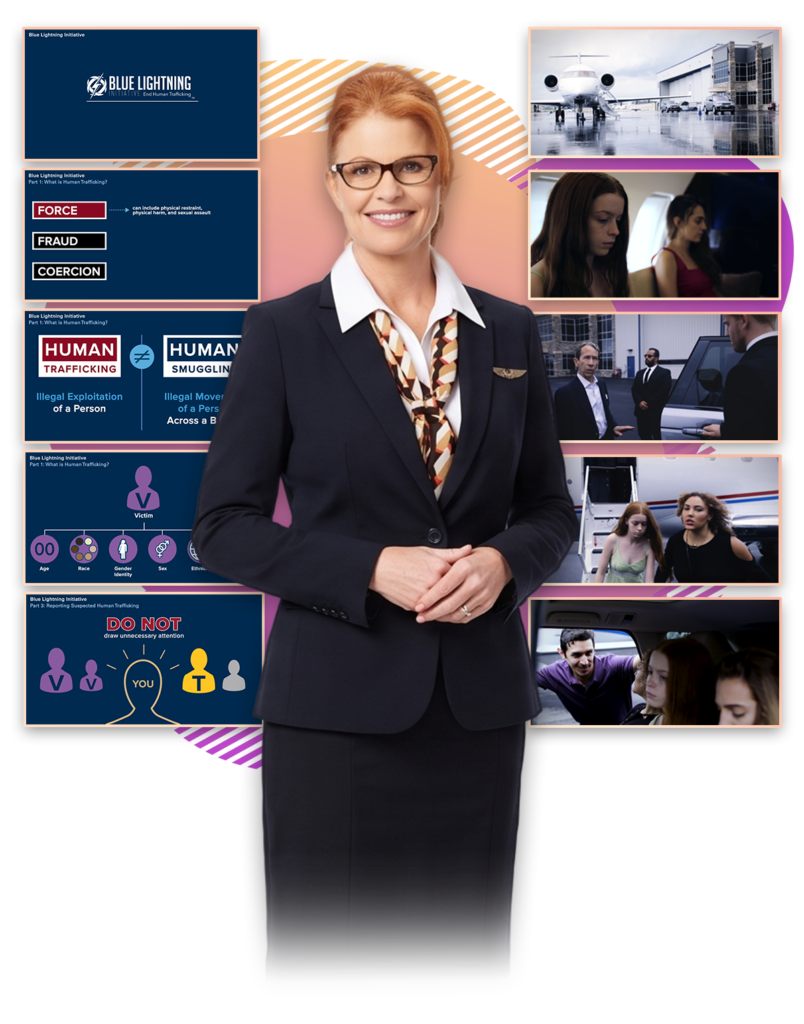
- Multimedia development from storyboard through draft-to-final production
- Professional narration and audio production
- 2D animated sequences, motion graphics, and purpose-built transitions
- On-screen text and visual learning elements timed to the narration
- Character and contextual illustration designed to demonstrate behavioral and situational indicators
- Client branding and previously developed graphical assets integrated for visual consistency
- Live-action narrative scenarios grounded in realistic aviation situations
- Instruction focused on recognition and appropriate reporting rather than intervention
- Collaborative script development with extensive stakeholder review
- Accessible media treatments, closed captions, and a screen-description transcript
- Standards-based LMS delivery, Section 508 / WCAG 2.1 AA–aligned

How We Delivered It
The HumanKind team members brought together project management, instructional design and scriptwriting, creative direction, technical development, live-action production, animation, and post-production.
The team translated approved client source content and established branding into finished multimedia—storyboards, 2D animation, motion graphics, narration, and on-screen text—through draft-to-final production and repeated stakeholder review cycles, maintaining visual consistency with the client’s existing materials.
Project management coordinated a particularly involved stakeholder review process, because scenario accuracy and sensitivity mattered as much as instructional effectiveness. The instructional and writing team worked closely with client representatives as scripts were refined and, in some cases, substantially revised. Script development continued into production, with instructional and production staff working together to preserve both the learning objectives and the authenticity of each scene.
Creative direction connected the live-action material with the broader visual experience, while 2D animation and motion graphics were developed to support the scenarios and reinforce learning without distracting from the people at the story’s center.
“Accessibility, media production, review, development, and quality assurance were built into the process, not treated as separate final steps. For a subject this sensitive, success depended on more than staying on schedule. It depended on creating space for the right people to challenge, refine, and improve the work.”
The Result
The finished course helped translate human trafficking awareness from an abstract concern into situations frontline professionals could recognize.
Rather than asking learners to memorize indicators, the experience showed how those indicators appear in context and reinforced the right actions when something seems wrong. It’s the difference between training that informs and training that performs.
The program supported a broader national aviation anti-trafficking initiative reaching hundreds of thousands of frontline employees, and it was recognized for its contribution to combating human trafficking.
But the most meaningful measure of the project was always simpler than an award or a completion count. Someone who encounters a potential trafficking situation may have only a few moments to notice that something is wrong. Good training cannot tell them exactly what they will see. It can help make sure they are paying attention when they see it.